A sample SEO audit report, in full
This is a complete technical SEO audit report, printed on this page
rather than hidden behind a form. It is a real report about a real website, ours,
generated on 13 September 2026 by the same tool that runs on any site you give it. Nothing has
been edited, including the findings that are not flattering.
How to read it
The report runs in the order a developer would work through it. The cover carries a
health score and the count of findings by severity. The executive summary states the
position in plain language. Then come the findings ranked by severity, each naming the
pages affected, followed by indexability, on-page signals, technical health, and a live
check of which pages Google is holding right now. The last section is what to do, in
order.
The section most audits leave out is the index check. A page can pass every technical
test in this document and still be absent from Google, and a page that is absent cannot
appear for any search at all, including one for your own business name. That is why it is
checked live against Google at the moment the report is generated rather than inferred
from the crawl.
Technical SEO audit
rank.fast
13 September 2026 · 12 pages crawled
98/100
Health score (Strong)
Executive summary
The audit crawled 12 pages on rank.fast and returned a score of 98. Every site-wide check passed, including HTTPS with HSTS, compression, cache headers, correct redirects, a valid robots.txt that declares a sitemap, a sitemap with lastmod values, proper 404 handling and a favicon. The single defect found is low severity: 2 meta descriptions exceed 160 characters.
All 10 pages checked against Google's index are present, with no missing URLs. Combined with server response times of 17 to 79 milliseconds across the crawl, this points to a site that search engines can reach and index without obstruction.
On-page fundamentals are consistent: all 12 pages have a title, a meta description and exactly one H1. Structured data appears only on the homepage. The priorities in this report are therefore refinements to an already sound technical base rather than repairs.
First impression
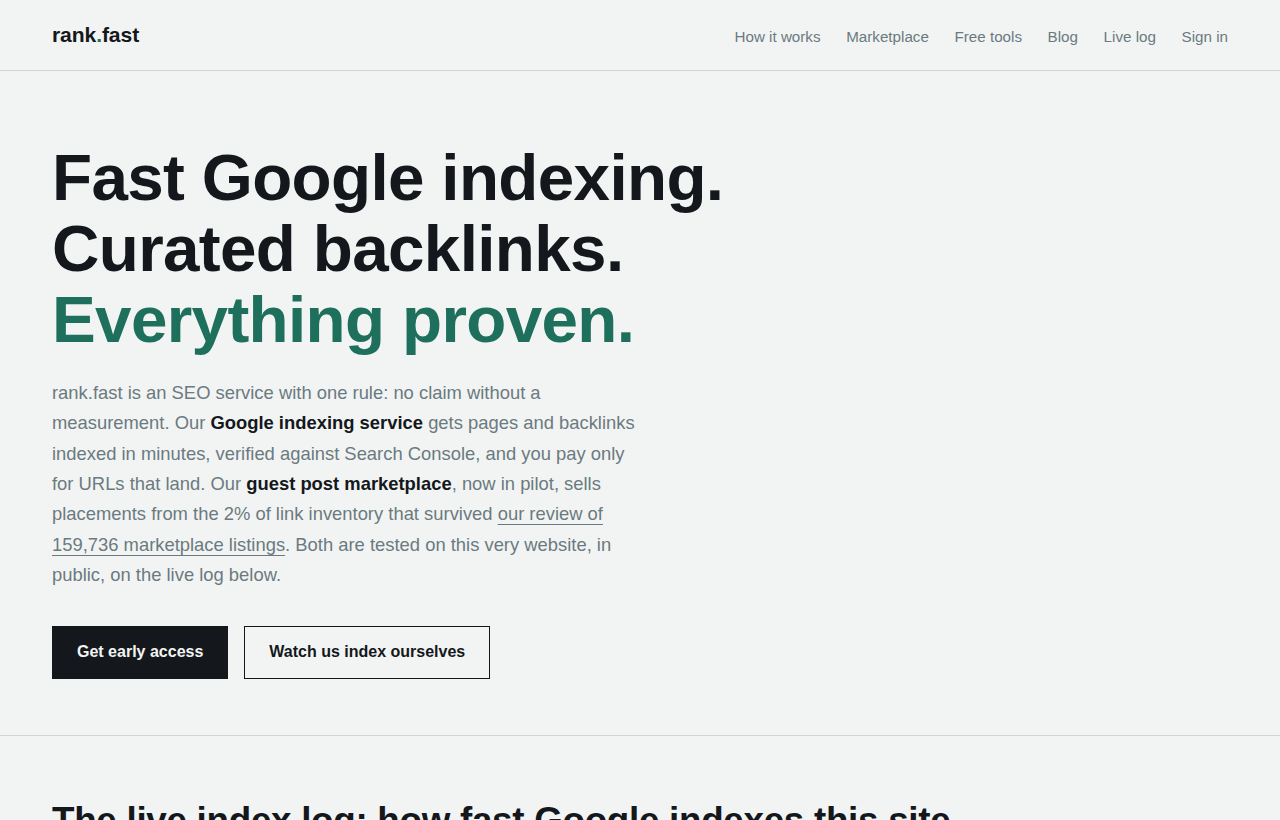
The site sells SEO services: a Google indexing product that gets pages and backlinks indexed quickly and charges only for URLs that land, plus a guest post marketplace currently in pilot selling placements from a filtered link inventory. It is aimed at SEO practitioners, link builders, agencies and site owners who already understand Search Console, indexation lag and link metrics, and who want third-party verification rather than vendor claims.
Visually it is a stripped-back, text-first layout on a warm off-white ground, with a single left-aligned column and a large, tightly tracked black sans-serif headline whose closing line shifts to a muted teal for emphasis. Hierarchy rests entirely on type scale and that colour shift, since there is no imagery, illustration or product screenshot; navigation is small, grey and visually recessive, and the two buttons are square-cornered, one solid black and one outlined white. The result is unfussy and credible but austere, and the hero column leaves a large empty right-hand area, while the grey body paragraph runs long and sits at low contrast against the background.
The primary call to action is legible but not self-explanatory: "Get early access" is the strongest button, yet the page never makes clear which product it unlocks or what happens after the click, and it competes with "Watch us index ourselves", which is the more distinctive offer. A first-time visitor will most likely click the black button out of conventional instinct, or scroll down to the live index log to test the proof claim, but many will hesitate at the vague gate and leave via the blog or free tools instead.
Findings, by severity
| Severity | Finding | Area |
|---|
| Low | 2 description(s) over 160 characters Descriptions are truncated around 160 characters in most result layouts. https://rank.fast/blog/google-recrawl (175 chars)
https://rank.fast/tools/google-index-checker (161 chars) | On-page |
Indexability and crawling
robots.txt is present and declares a sitemap, and the sitemap is valid with lastmod values, giving crawlers a direct discovery path. HTTP redirects behave correctly and 404s return a proper status code rather than a soft 200, so crawl paths and error handling are clean. Internal linking supports discovery: the homepage carries 38 internal links, the blog index 28, individual posts 14 to 16 each and the tool page 15.
Response times across the 12 crawled pages ranged from 17 to 79 milliseconds, which keeps crawl efficiency high. Compression and cache headers are in place site-wide.
Nothing in the crawl indicates a barrier to indexing. Every page returned a single H1 and complete metadata, and the indexation check confirms the structure is working in practice.
Site level checks
| Check | Result |
|---|
| Served over HTTPS | Pass |
| http redirects to https | Pass |
| HSTS header present | Pass |
| Valid robots.txt | Pass |
| Sitemap declared in robots.txt | Pass |
| XML sitemap reachable | Pass |
| Sitemap uses lastmod | Pass |
| Missing pages return 404 | Pass |
| Cache-Control header set | Pass |
| Compression or light HTML | Pass |
| Favicon present | Pass |
On-page signals
Every one of the 12 pages has a specific title tag, from 'rank.fast: fast Google indexing and curated backlinks' on the homepage to individual post titles such as 'Four ways into Google's index, timed'. No duplication was flagged.
Meta descriptions are present on all 12 pages. The only on-page defect in this audit is that 2 of them exceed 160 characters and will truncate in search results; trimming them is the one corrective action required here.
Headings are disciplined: each of the 12 pages has exactly one H1, with no page missing one or carrying multiples. This consistency, alongside full description coverage, gives Google clean on-page signals on every template.
Content and internal linking
Body copy is substantial on most templates. Blog posts run between 546 and 986 words, the homepage carries 861 words, the how-it-works page 623 and the blog index 763. The lightest page is the Google Index Checker tool at 252 words; the legal pages at 419 and 348 words are unremarkable for their type.
Internal linking follows a hub pattern: the homepage links to 38 internal targets and the blog index to 28, with posts cross-linking 14 to 16 pages each. Within this 12-page crawl no page appears disconnected, and linking density is more than sufficient for Google to reach every URL from the homepage.
Technical health
Security and transport fundamentals are in place: the site serves over HTTPS with HSTS enabled. Performance signals are equally sound, with compression and cache headers present site-wide and response times of 17 to 79 milliseconds across all 12 pages. Structured data is limited to the homepage, which carries Country and Organization schema; the other 11 pages carry none. Device-specific rendering was not part of this crawl, so no mobile findings are reported.
The combination of fast responses, clean redirects and correct error handling leaves little technical friction for crawlers. The main technical opportunity, grounded in the crawl data, is extending structured data beyond the homepage, for example Article markup on the six blog posts.
Page by page
| URL | Status | Title | Desc | H1 | Words | Links | ms |
|---|
| rank.fast/ | 200 | rank.fast: fast Google indexing and curated backlinks | yes | 1 | 861 | 38 | 65 |
| rank.fast/how-it-works | 200 | How Google indexing works | yes | 1 | 623 | 17 | 57 |
| rank.fast/blog | 200 | The build log: SEO experiments measured in public | yes | 1 | 763 | 28 | 67 |
| rank.fast/blog/day-zero | 200 | Day zero: indexing a domain nobody links to | yes | 1 | 546 | 16 | 18 |
| rank.fast/blog/the-race | 200 | Four ways into Google's index, timed | yes | 1 | 558 | 15 | 66 |
| rank.fast/blog/marketplace-study | 200 | We reviewed 159,736 backlink listings | yes | 1 | 694 | 15 | 17 |
| rank.fast/privacy | 200 | Privacy policy | yes | 1 | 419 | 10 | 27 |
| rank.fast/terms | 200 | Terms of service | yes | 1 | 348 | 11 | 28 |
| rank.fast/blog/pilot-protocol | 200 | Our guest post pilot protocol | yes | 1 | 986 | 15 | 18 |
| rank.fast/blog/crawled-not-indexed | 200 | Crawled, currently not indexed: how long it lasts | yes | 1 | 738 | 15 | 39 |
| rank.fast/blog/google-recrawl | 200 | How to get Google to recrawl a page: we timed it | yes | 1 | 613 | 14 | 79 |
| rank.fast/tools/google-index-checker | 200 | Free Google Index Checker | yes | 1 | 252 | 15 | 18 |
Are these pages actually in Google?
Most audits check whether a page could be indexed. This one also
checks whether it is, by querying Google for each exact URL at the time of the audit. A page that is crawlable,
well written and absent from this list is not blocked: it is simply not in the index yet.
The indexation check covered 10 of the 12 crawled URLs, and all 10 are in Google's index right now, with no missing entries. The usual causes of absence, robots blocking, thin content exclusion or a discovery gap, are not evidenced anywhere in this dataset. The two crawled URLs outside the checked sample have unverified live status, so the accurate statement is that the site is 10 for 10 on everything tested rather than 12 for 12.
Indexation at this level is consistent with the rest of the audit: a sitemap declared in robots.txt, 14 to 38 internal links routing through every template, sub-80-millisecond responses and proper 404 handling. What changes it is change itself: new pages start unchecked, rewrites can temporarily unsettle crawlers, and removed internal links can isolate URLs. Re-run the index check after each significant publish or restructure rather than assuming current inclusion persists.
| URL | In Google's index |
|---|
| rank.fast/privacy | Yes |
| rank.fast/blog/the-race | Yes |
| rank.fast/blog/marketplace-study | Yes |
| rank.fast/blog/day-zero | Yes |
| rank.fast/ | Yes |
| rank.fast/blog/pilot-protocol | Yes |
| rank.fast/terms | Yes |
| rank.fast/blog | Yes |
| rank.fast/blog/crawled-not-indexed | Yes |
| rank.fast/how-it-works | Yes |
Checked live at the time of this report. Google's index changes continuously; a page missing today may
appear tomorrow, and the reverse is also true.
What to do, in order
- Trim the 2 meta descriptions over 160 characters so they display in full in search results.
- Verify the indexing status of the two crawled URLs not covered by the 10-URL index check.
- Add structured data to the six blog posts and remaining templates, which currently carry none beyond the homepage's Country and Organization schema.
- Expand the supporting copy on the Google Index Checker page, the shortest on the site at 252 words, to give that template more context for crawlers.
- Keep sitemap lastmod values accurate whenever a page changes so recrawl prioritisation stays correct.
- Preserve the current response times of 17 to 79 milliseconds when adding templates or third-party scripts.
- Maintain single H1s and full description coverage on all new pages.
The next 30 days
If the actions above are completed, expect the score to hold at or near 98 with the description issue cleared, structured data present across all templates and the full set of 12 URLs brought inside the verified sample on the next index check. No change in rankings can be promised; what this audit speaks to, indexation and technical health, should remain at its current level, with monitoring in place to catch any future exclusion early.
Check your own indexing, free
This audit checks whether pages can be indexed. To see which of your URLs
Google has actually indexed right now, with a diagnosis for each one that is not,
use the free checker at rank.fast/tools/google-index-checker/ (no signup, five URLs a day).
Measured indexing statistics, including how long indexing really takes, are published at
rank.fast/stats/google-indexing-speed/
The weekly email. Next issue: what ten bought guest posts did to a new site's indexing, every number published. One short email a week, one-click unsubscribe. Join at rank.fast/blog/.
How this report was produced
Every finding above was measured on the live site on the date shown, not estimated or modelled.
Pages were fetched as a search engine would fetch them and inspected for HTTP status, redirects, canonical tags,
robots directives, titles, meta descriptions, heading structure, word counts, image alt text, internal and external
linking, mobile viewport, structured data, Open Graph tags, response time and document weight. Site level checks
covered HTTPS and its redirect, HSTS, compression, cache headers, robots.txt validity and sitemap declaration,
XML sitemap reachability and lastmod usage, 404 handling and favicon. Index status was checked against Google
directly for each crawled URL. Nothing in this report is drawn from third party estimates of traffic or authority.