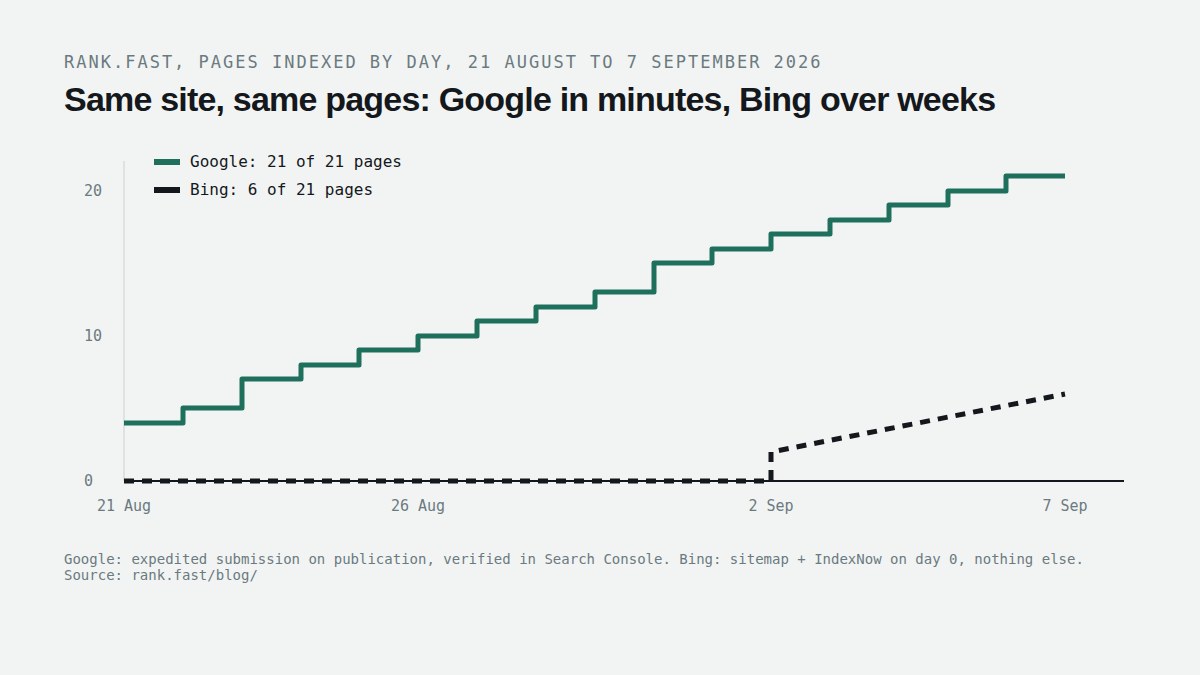
If you search "why is my site not indexed on Bing", the answers say to verify the site, submit a sitemap, check robots.txt, and wait. We did all of that on day one, so we can tell you what waiting looks like with numbers on it. This site launched on 21 August with no history. Google had every page within minutes. Bing had none of them for twelve days, then started, slowly, on its own.
What both engines were given
The technical state was identical for both, and it was clean: pages returning 200, no noindex tags, a permissive robots.txt, an XML sitemap with lastmod, HTTPS, a verified property in each engine's console, and an IndexNow ping for every new URL, which Bing consumes directly. Bing's own crawler visited normally from the first days, dozens of fetches, all returning 200, nothing blocked. Discovery was not the problem. Bing knew every page existed and chose to hold them.
What Google did
Every page went through an expedited indexing route on publication and was verified in Search Console. The live log on the homepage has each timestamp. The short version: first Googlebot visit within seconds of submission, indexed within minutes for most pages and within a few hours for the slowest. Twenty-one pages published, twenty-one indexed. This is the paid product, and it is what it is for.
What Bing did
| Day | Date | Pages in Bing | What we did |
|---|---|---|---|
| 0 | 21 Aug | 0 | site live, sitemap, IndexNow |
| 5 | 26 Aug | 0 | property re-verified by meta tag; nothing else to fix |
| 12 | 2 Sept | 2 | nothing |
| 17 | 7 Sept | 6 | nothing |
At day twelve, Bing's URL inspection tool showed the held pages as "discovered" with the message that the URL "cannot appear on Bing" because of "some issues which are preventing indexation", while the live URL test on the same page passed every check. That combination, a green live test and a refusal to index, is Bing saying the page is fine and the domain has not earned it yet.
Two details make the trust reading firm. The first pages Bing let in were the homepage and one page it had crawled early, shown with an old title from before we tidied the titles on 31 August, so it was working from a stale snapshot rather than a fresh crawl. And by day seventeen, Bing's links report already listed most of the guest post backlinks pointing at us, published between 28 August and 4 September. Bing had found the links before it was willing to index the pages they pointed at. Its link discovery ran ahead of its indexing, which is not how a discovery problem behaves.
Why the two engines differ
Google will index a new domain's pages on submission and let ranking sort them out later. Bing appears to gate the index itself on domain trust, and a domain with no history, no links and no traffic starts below the gate whatever its pages look like. The things that move it are the ones that arrived during these seventeen days: links from established sites, repeated crawls that keep returning clean pages, and time. Bing's own guidance says as much in gentler language.
One more data point, added on the day of publication: for our own name, "rank fast", Bing now returns this site first, ahead of the several older companies that share the name, while it still holds fifteen of our pages out of its index. Ranking the pages it has admitted and admitting the rest are evidently separate decisions.
The practical consequence for a new site is that there is nothing to fix once the technical checks pass, and repeated resubmission does nothing. We requested indexing for the held pages on day twelve. It did not visibly change the pace. What changed the pace was the links, or time, and this record cannot separate the two.
What this proves, and what it does not
- It shows the same clean pages entering Google within minutes and Bing over weeks, on one domain, with dates. For a new site, Bing's wait is expected, not an error to debug.
- It shows that Bing can hold pages it has crawled and found clean, and say so in words that sound like a technical fault when they are not.
- It does not measure what specifically lifted the hold. The pilot links and the passage of time overlap completely in this record.
- Six of twenty-one pages is where Bing stood on 7 September. We will add the count at the pilot's 30-day checkpoint and again in mid-October, whichever way it goes.
If your own new site is in the same position, the free index checker tells you which of your pages Google has, with a diagnosis for the ones it does not, and the technical audit report confirms whether anything on your side is blocking either engine. If both come back clean, the honest answer for Bing is the one above.