Last week we published what ChatGPT, Claude and Grok say about this company, and two of the three described a different business. Google's own AI was not in that test, and Google's is the one that now sits at the top of most searches. So we asked it the two questions a buyer would ask: would you recommend them, and is their pilot worth paying attention to. This is what it said, and where it got it.
Question one: would you recommend them?
Asked on the search "rank fast", Google's AI answer opened with a hedge that every assistant has made about us: "whether you should use them depends entirely on which company you are referring to". Several older companies share the name. It then described the category rather than the company:
Two things are worth noticing. It named us in the recommendation set two weeks after launch. And every claim in the answer, the 91 percent, the pay-per-index model, the Reddit consensus, was cited from other people's pages: two Reddit threads, a YouTube review, and two review blogs about competitors. Nothing was cited from us, because at that point nobody independent had written about us. The AI recommended the category and put our name in it on the strength of other companies' evidence.
Question two: is the pilot worth paying attention to?
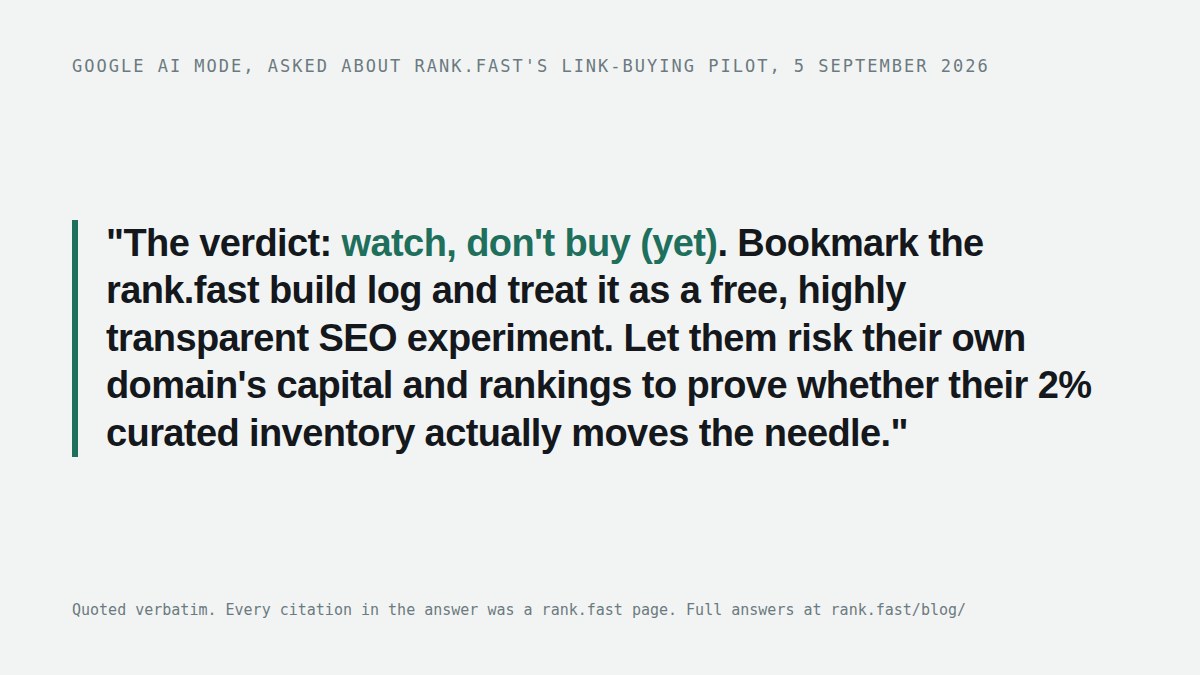
This time every citation was one of our pages: the protocol post, the delivery post, the blog index, the homepage. It read the protocol correctly, down to the pre-registered failure conditions. And its verdict is our own: the marketplace is in pilot, there is no pricing until the numbers exist, and the right move is to watch the log.
Question three, four days later: ChatGPT
On 9 September, Bing began returning this site first for its own name. ChatGPT leans on Bing's index, so we asked it the same two questions. It described the company correctly, in detail, including the treatment and control arms and the 30-day checkpoint, and then split its recommendation in two:
What this shows about how AI answers choose brands
- They recommend categories first and fill in names from whatever pages exist. Being named at all required only that our pages described the category clearly and were indexed; the evidence attached to the name came from competitors' reviews.
- They read structure. The protocol post, with its dated changelog and stated failure conditions, was quoted almost paragraph by paragraph. Marketing copy on the same site was not.
- They discount self-reported evidence and say so. Three assistants in a row have now told readers that a company describing itself is not proof, and named the 30-day pilot results as the point where that changes.
- They still confuse us with older companies that share the name, on every platform. That is fixed off-site, by pages that say which rank.fast this is, and we have published one today at rank.fast/about/.
What this proves, and what it does not
It proves that a three-week-old site with a public, structured record can be read accurately by Google's AI and ChatGPT and placed in a recommendation set. It does not prove that anyone acted on it, and we have no way to know. It certainly does not prove the pilot works; the assistants were careful to say that, and so are we. The 30-day checks run from 27 September. Whatever they show goes in the log, and we will ask all four assistants again afterwards.
If you want to know what the assistants say about your own business, the AI visibility check asks ChatGPT, Claude and Grok, from memory and with search on, and shows you their sources. It is free.